
In companies, AI agents handle tasks that go beyond single automation steps: they take a goal, plan the steps required, use tools such as CRM, email or databases, and adjust their approach when something does not work. A language model (LLM) that understands instructions in natural language serves as the "brain". This guide shows you where agents deliver value in companies today, which use cases have proven themselves, which obstacles you need to plan for and how to set up a first project.
What are AI agents and how do they work?
An AI agent is a software system that works on the principle of "perceive, decide, act". Unlike a script or a simple chatbot, it can plan and execute tasks across several steps and react to intermediate results along the way.
The architecture: the LLM as the control center
The difference from earlier, rule-based systems lies in the language model. It takes on three jobs:
- Planning: Breaking a task down into intermediate steps.
- Tool selection: Deciding which tool (API, database, browser) is needed next.
- Reflection: Evaluating results and adjusting the plan when needed.
This lets agents take on tasks that used to require a minimum of judgment, such as classifying unstructured requests. You can find a detailed introduction at What is an AI agent?.
Agent vs. chatbot
| Characteristic | AI agent | Chatbot/assistant |
|---|---|---|
| Autonomy | High. Plans and executes multi-step tasks on its own. | Low. Responds to direct input. |
| Goal orientation | Works toward a goal (e.g. "Prepare the quotation documents"). | Focused on the current conversation. |
| Complexity | Can combine tools and react to intermediate results. | Limited to simple, linear interactions. |
| Scope of action | Accesses external systems (e.g. sending emails, creating CRM entries). | Usually limited to information. |
What AI agents bring to a company
1. Relief from recurring knowledge work
Agents take over tasks that have cost time so far but leave little room for decisions: pre-sorting requests, transferring data from documents, preparing reports. Your team can focus on cases that require experience and coordination.
2. Faster input for decisions
Agents can summarize large amounts of unstructured data. An analysis agent, for example, combines sales figures, customer feedback and market data and delivers a report with sources, which a specialist then reviews and adds to.
3. Scaling under fluctuating load
Agents work around the clock. During seasonal peaks in customer service, requests can be pre-sorted and standard cases prepared without you having to add staff at short notice. Keep in mind that quality must be checked at high volume just as carefully as in testing.
Proven use cases
Marketing and sales
- Lead qualification: An agent scores incoming leads against fixed criteria, adds publicly available company data and sets the priority in the CRM.
- Content preparation: Agents research topics, create drafts for product descriptions or blog posts and check existing content for outdated information. An editorial team approves the result.
- Quotation preparation: An agent collects customer data, previous quotes and price lists and creates a draft.
IT and support
- First-level support: Agents answer standard requests such as password resets or status queries and hand complex cases over to people along with all the information collected.
- Monitoring: An agent analyzes logs, detects anomalies and proposes actions. Automatic interventions such as a restart should be limited to clearly defined, low-risk actions.
- Software development: Coding agents work on tickets, write tests and open pull requests that developers review.
HR and finance
- Incoming invoices: An agent reads invoices, matches them against purchase orders and prepares the booking.
- Expense checks: Receipts are checked against the travel expense policy and deviations are flagged.
- Job applications: Agents can structure and summarize application documents. Under the EU AI Act, automated pre-selection of applicants counts as a high-risk application and is subject to strict obligations; without a thorough legal review, you should not automate any decisions here.
Challenges during rollout
There is often a wide gap between pilot and production. Only 13 % of IT application leaders surveyed by Gartner strongly agree that they have the right governance structures for agents. Gartner also expects more than 40 % of agentic AI projects to be cancelled by the end of 2027 because of escalating costs, unclear business value or inadequate risk controls. Our sister project compiles both figures in the Agentic Organization Index Q3 2026 (in German). Three areas decide whether a project makes it.
1. Security and compliance
Agents access company data and systems. That is why the following applies:
- Least privilege: Each agent gets only the permissions it needs for its task.
- Logging: All actions are stored in a traceable way.
- Approvals: A person confirms critical actions (payments, contract changes, external emails).
- Prompt injection: Content from emails, documents or websites can contain hidden instructions. Treat it as data, not as commands.
- Regulation: GDPR applies to all personal data. Depending on the use case, the EU AI Act sets additional requirements, such as transparency obligations for chatbots or extensive obligations for high-risk applications.
2. Integration into existing IT
Agents need to talk to CRM, ERP, ticketing systems and databases. Standardized interfaces such as the Model Context Protocol (MCP) make this easier. For sensitive data, running the agent on your own infrastructure or in an EU cloud region may be necessary.
3. Acceptance and change
New systems change workflows. Involve the affected teams early, explain which tasks the agent takes over and which it does not, and define who is responsible for the results. For rollouts in Germany, the works council may have to be involved, depending on how the system is set up.
How to start a first project
- Choose a use case: A task with high volume, clear rules and a verifiable result.
- Measure the baseline: How long does the task take today, and what is the error rate?
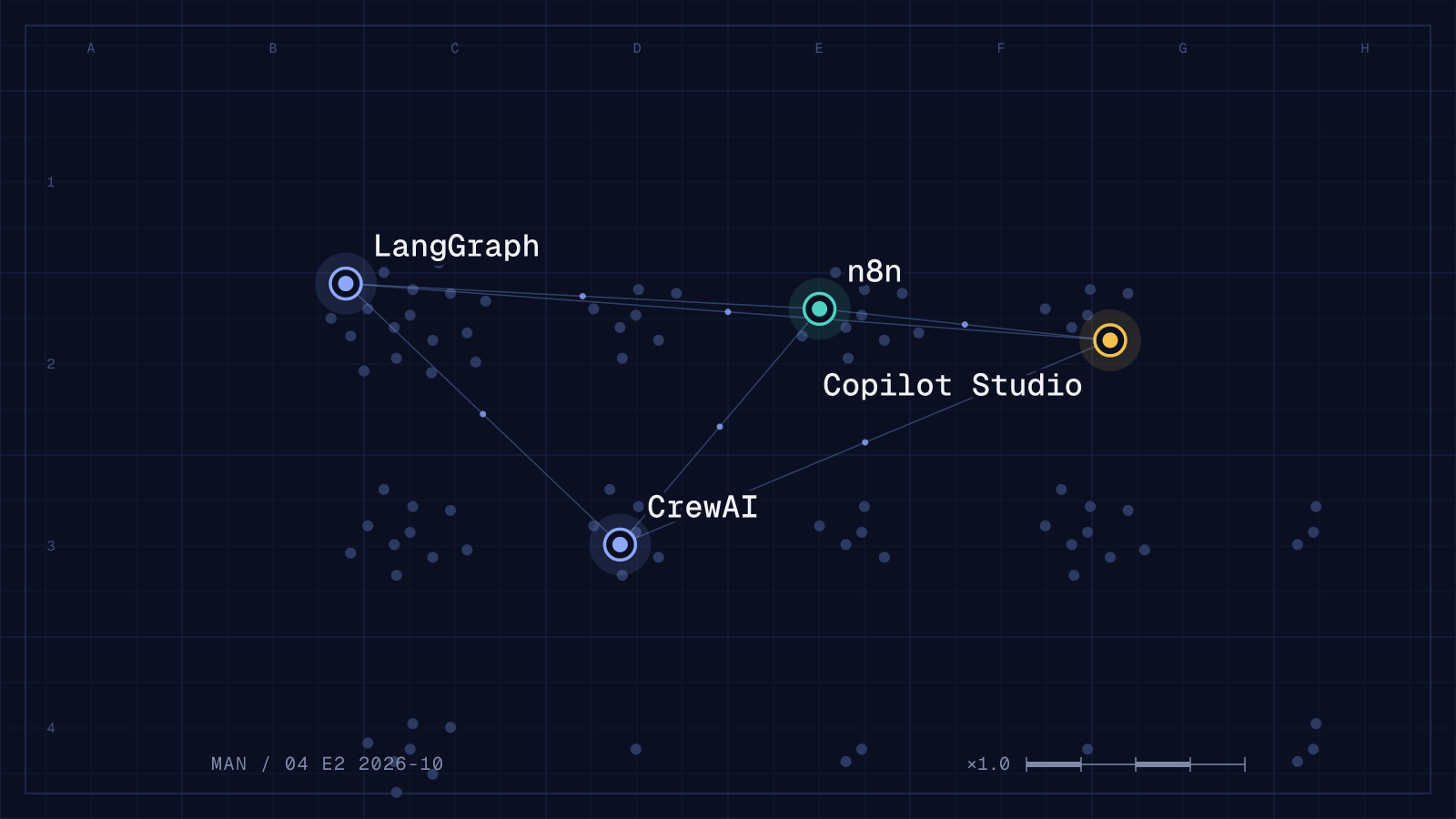
- Choose a tool: A no-code platform (e.g. n8n, Copilot Studio) or a framework (e.g. LangGraph, CrewAI). See Build an AI agent and AI agent comparison.
- Pilot with approvals: The agent makes suggestions, people decide.
- Evaluate: Compare quality, time savings and costs against the baseline.
- Expand step by step: Only reduce approvals or add further cases once the pilot runs reliably.
Frequently asked questions
What is the difference between an AI agent and a simple script?
A script executes a fixed sequence of commands. An AI agent interprets a goal, plans several steps, uses tools and adjusts the plan when a step fails or the situation changes.
Are AI agents safe with regard to company data?
That depends on the implementation. With least privilege, logging, approvals for critical actions and a vetted model provider (data processing agreement, data location), the risk can be kept well under control. Many companies use models through the EU regions of Azure, AWS or Google Cloud or run open models themselves.
What costs are involved?
Three areas: operations (model usage per token, platform or hosting), development (adaptation to processes, integration, testing) and ongoing support (training, maintenance, quality control). Whether an agent pays off only becomes clear when you compare it against the measured baseline in the pilot.
How long does a rollout take?
A simple agent for a clearly defined task can be productive within a few weeks. Agents that reach deep into ERP or core systems tend to need several months, mainly because of integration, testing and approval processes.
What role do employees play?
Employees set goals and rules, review results, correct errors and handle the cases that require experience, negotiation or empathy. Without this role, the quality of an agent declines over time.
Next steps
Use the System Finder to find platforms that fit your requirements, or take a look at the AI agent comparison. If you are looking for help with implementation, the service providers directory lists specialized firms.
Sources
- Gartner: Survey of IT application leaders on AI agents (30 Sep 2025)
- Gartner: Over 40% of Agentic AI Projects Will Be Canceled by End of 2027 (25 Jun 2025)
- Agentic Organization Index Q3 2026: governance chart (in German)
- EU AI Act: Regulation (EU) 2024/1689
- European Commission: Regulatory framework on AI
- OWASP Top 10 for LLM Applications
- Model Context Protocol
- Anthropic: Building effective agents